


The intersection of academic ambition and technological representation reached a critical flashpoint in February 2026 during the India AI Impact Summit in New Delhi. Galgotias University, a private institution based in Greater Noida, became the center of international scrutiny after a video went viral showing a faculty member presenting a sophisticated quadruped robot as an in-house development of the university’s “Centre of Excellence.” The device was rapidly identified by the global robotics community as a commercially available product from a Chinese manufacturer, leading to allegations of plagiarism, misrepresentation, and a subsequent order for the university to vacate its exhibition space.
The controversy began when Neha Singh, a professor of communications at Galgotias University, introduced a robotic dog named “Orion” to the state-run broadcaster DD News. During the interview, Singh stated, “You need to meet Orion. This has been developed by the Centre of Excellence at Galgotias University.” However, eagle-eyed social media users and robotics experts quickly identified the machine as the Unitree Go2, a bionic quadruped robot manufactured by the Hangzhou-based firm Unitree Robotics. The Unitree Go2 is a well-known research and education tool sold globally for approximately $2,800 (roughly ₹2.3 to ₹3 lakh).
Technical Specifications of the Unitree Go2
To understand why the identification was so immediate, one must look at the distinct engineering of the Unitree Go2. As detailed in robotics literature, the Go2 is an evolution of the Go1, featuring an integrated 4D LiDAR L2 sensor that provides a 360∘×90∘ hemispherical ultra-wide-angle recognition system. This allows the robot to map environments in real-time with high precision.
The robot’s physical capabilities are governed by high-torque joint motors. The peak torque of these motors is approximately 45Nm, allowing for a maximum running speed of roughly 5m/s. Its mobility is supported by 12 aluminum alloy precision joint motors and a “Smart Battery” system available in 8,000mAh or 15,000mAh capacities, providing an endurance of 2 to 4 hours. The inclusion of the Intelligent Side-follow System (ISS 2.0) and a front-facing wide-angle camera are signature traits of the Unitree brand that made the “Orion” rebranding easily detectable.
Escalation and Institutional Response
The embarrassment for the university was compounded when India’s Union Minister for Electronics and Information Technology, Ashwini Vaishnaw, shared the video of the robot on his official social media account, seemingly endorsing it as an Indian innovation. He later deleted the post as the backlash intensified. The Indian National Congress, the primary opposition party, seized the moment to criticize the government, claiming the incident made India a “laughing stock” on the global stage during a summit intended to showcase the nation’s AI prowess.
In response to the outcry, Galgotias University issued several clarifications. The university registrar, Nitin Kumar Gaur, argued that the controversy stemmed from a semantic misunderstanding between the words “develop” and “development.” He claimed the university was working on the development of applications for the robot rather than claiming to have developed (manufactured) the hardware from scratch. Professor Neha Singh also defended her statements, suggesting she may have been “confused by the words” in the heat of the moment, and reiterated that the robot was intended as a “learning tool” for students.
Secondary Allegations: The Soccer Drone
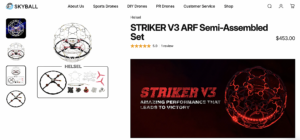
The scrutiny on Galgotias University expanded beyond the quadruped robot to include a “soccer drone” showcased at the same event. University representatives claimed the drone was a fully indigenous, “end-to-end” engineering project developed on campus. However, online investigators identified the drone as the Striker V3 ARF, a product manufactured by the South Korean firm Helsel Group. The Striker V3 is a standard model used in international drone soccer leagues and is commercially available in India for approximately ₹40,000. This second instance of alleged misrepresentation further damaged the institution’s credibility at the summit.
Consequences and the India AI Impact Summit
The India AI Impact Summit 2026 was billed as a landmark event for the Global South, featuring speakers such as Prime Minister Narendra Modi, Sundar Pichai (Google), Sam Altman (OpenAI), and Dario Amodei (Anthropic). Despite the summit securing over $100 billion in investment pledges from entities like the Adani Group and Microsoft, the “robodog” incident cast a shadow over the proceedings.
Government sources reported that the IT Secretary, S. Krishnan, took a firm stance, stating that exhibitors would not be permitted to present items that were not their own original creations. Consequently, Galgotias University was reportedly asked to vacate its stall, and power to their exhibition space was cut. While university officials initially denied receiving formal communication regarding their removal, media reports confirmed the stall was empty by the final days of the expo. This incident serves as a cautionary tale in the academic and tech communities regarding the ethics of “white-labeling” existing technology and the importance of transparency in research and development.
Ref: