


The emergence of “agentic” and generative artificial intelligence (GenAI) has initiated a profound structural shift in the enterprise software landscape, leading to a market correction exceeding $300 billion in early 2026. Historically, the software-as-a-service (SaaS) model relied on “seat-based” pricing and high switching costs to maintain stable, recurring revenue. However, the advent of tools such as Anthropic’s Claude “Cowork” and OpenAI’s “Frontier” has introduced the capability to automate complex, multi-step business workflows—ranging from legal document review to financial reconciliation—without the need for traditional, specialized software interfaces. This transition from AI as an assistant to AI as a substitute has forced investors to reassess the long-term profitability and pricing power of industry incumbents like Salesforce, ServiceNow, and Oracle.
The disruption is most visible in the realm of software development itself. Generative AI tools are now capable of writing usable code, performing automated testing, and refactoring legacy systems with unprecedented speed. Research indicates that developers using AI-powered coding assistants can experience productivity gains of 35% to 55%. While this increases efficiency, it also lowers the barrier to entry for creating custom, in-house software, potentially allowing enterprises to “build” rather than “buy” their core operational tools.
Economic and Structural Shifts in SaaS
The traditional economic moat of software companies—proprietary code and embedded workflows—is being challenged by the “commoditization” of software creation. When the cost of generating code approaches zero, the value of a software company shifts from the code itself to the “System of Record” (SoR).
- Systems of Engagement (SoE): These are the user interfaces and dashboards where humans interact with data. AI agents are rapidly replacing these layers by allowing users to query data via natural language, bypassing traditional UI/UX.
- Systems of Record (SoR): These are the authoritative databases for financial, customer, and compliance data. Because these require absolute accuracy and auditability, they remain more resilient to AI disruption than engagement-layer tools.
The market sell-off, often termed a “SaaSpocalypse,” reflects a fear that AI will erode the “per-seat” revenue model. If an AI agent can perform the work of five junior analysts, a company may only require one software license instead of six, leading to a significant contraction in the addressable market for SaaS vendors.
Automation of Professional Workflows
Beyond coding, “agentic” AI is targeting high-value professional tasks. Anthropic’s release of plugins for legal, marketing, and sales tasks triggered sharp declines in stocks like Thomson Reuters and LegalZoom. These tools can perform:
- Legal & Compliance: Automating contract reviews and regulatory document analysis.
- Data Analytics: Generating SQL-based reports and data visualizations from plain-language prompts.
- Customer Service: Replacing human-led call centers with autonomous AI chatbots capable of resolving complex queries.
Impact on the Global Labor Market
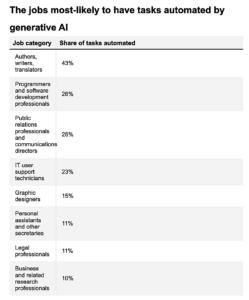
The displacement of tasks is particularly acute in entry-level white-collar roles. Reports suggest that up to 26% of tasks performed by programmers and software developers are at risk of automation. Junior software engineering roles have already seen a decline of nearly 20% over a three-year period as AI takes over “boilerplate” coding and routine debugging. However, experts argue that humans remain essential for “judgment problems”—tasks involving market timing, ethical considerations, and complex business logic that AI cannot yet replicate.
June 2023: The jobs most likely to have tasks automated by generative AI
Future Outlook and Industry Adaptation
To survive, incumbent software providers are pivoting toward “Vertical AI Operating Systems.” This involves fusing foundation models with proprietary industry data that cannot be easily scraped or replicated. For example, a healthcare software provider might integrate AI that understands specific payer rules and clinical workflows, creating a moat based on “context” rather than just “code.” While the immediate market reaction has been volatile, the long-term transformation suggests a shift from software as a tool to software as an autonomous service, where value is measured by outcomes rather than the number of human users.
Ref:
- https://theconversation.com/ai-threatens-to-eat-business-software-and-it-could-change-the-way-we-work-275546
- https://www.linkedin.com/posts/deanbarber_ai-wiped-out-400-billion-this-week-and-activity-7425902124154261504-em_5
- https://finance.yahoo.com/news/the-ai-fueled-software-meltdown-is-overblown-195456346.html
- https://www.linkedin.com/posts/maniruthwik-macha-0049962a2_ai-futureofwork-software-activity-7425018541151748096-HC0_
- https://market.us/report/generative-ai-in-software-and-coding-market/
- https://www.mckinsey.com/industries/technology-media-and-telecommunications/our-insights/navigating-the-generative-ai-disruption-in-software
- https://www.itpro.com/technology/artificial-intelligence/report-reveals-the-tech-jobs-worst-hit-by-generative-ai-automation
- https://venturebeat.com/ai/business-leaders-fret-about-generative-ai-despite-growing-adoption
- https://www.deloitte.com/us/en/insights/industry/technology/gen-ai-coding-tools.html